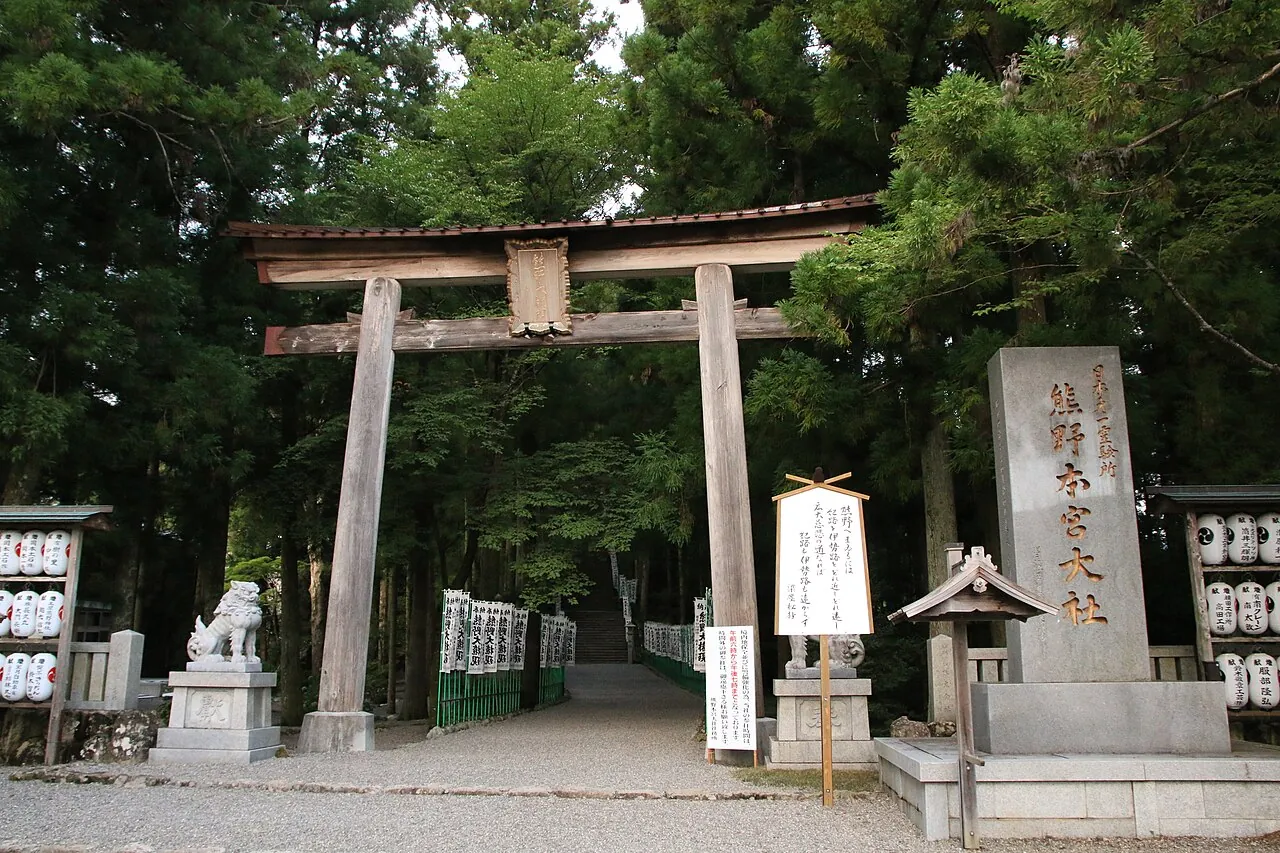
The torii at Kumano Hongu Taisha in August. Photo: nimame / Wikimedia Commons / CC BY 2.0

- The tourism bureau says the Nakahechi is open year-round but asks walkers to avoid extreme weather; it calls spring and fall the popular seasons and says summers are often hot, humid and wet.
- At Kurisugawa, near the trail, the 1991–2020 normals give 387.5 mm of rain in June and 395.0 mm in July, against 134.0 mm in November and 86.9 mm in December.
- From the end of December to the end of February there is a chance of freezing temperatures and snow, and lodgings are often fully booked over New Year, Golden Week and Obon.
Go in November or April, and avoid Japanese national holidays.
The tourism bureau calls spring and fall the popular seasons; November has about a third of July's rain at Kurisugawa, near the trail.
June to September is the wettest stretch, and summer is hot and humid, so start early if you go then. Buses can be full in peak spring and fall.
Lodging is often fully booked over New Year, Golden Week and Obon, Kumano Travel says, and its requests close 20 days before your stay, so book November or April well ahead.
- 1NovemberPopular; 134.0 mm of rain; short days
- 2AprilPopular; 199.2 mm of rain
- 3December–FebruaryLeast rain; chance of freezing temperatures
When is the best time to hike the Kumano Kodo? For a first walk on the Nakahechi, I would go in November or April. The tourism bureau calls spring and fall the popular seasons; summer is hot, humid and wet, and winter can bring frost. The bureau says the Nakahechi is open year-round, but that does not make every day safe: it asks walkers to avoid extreme weather and to check conditions each day. Within that, the choice is about rain, heat, daylight and crowds.
Below is what the official figures say, month by month, for the Nakahechi, the main route and the one the bureau describes section by section. Figures were checked on official pages on October 25, 2026. For routes, buses and lodging, see my Kumano Kodo without a car guide.
Month by month: rain and temperature near the trail
The Japan Meteorological Agency's Kurisugawa station is at 160 m in Kurisugawa, the village whose bus stop comes just after Takijiri on the road to Hongu. These are its 1991–2020 normals.
| Month | Average | Average daily high | Average daily low | Rain (month total) |
|---|---|---|---|---|
| January | 4.0°C | 10.5°C | −1.2°C | 91.9 mm |
| February | 4.8°C | 11.6°C | −1.0°C | 113.7 mm |
| March | 8.3°C | 15.2°C | 2.1°C | 182.0 mm |
| April | 13.2°C | 20.1°C | 6.7°C | 199.2 mm |
| May | 17.6°C | 24.3°C | 11.7°C | 250.8 mm |
| June | 21.2°C | 26.5°C | 17.0°C | 387.5 mm |
| July | 25.0°C | 30.1°C | 21.3°C | 395.0 mm |
| August | 25.7°C | 31.5°C | 21.6°C | 262.7 mm |
| September | 22.6°C | 28.6°C | 18.3°C | 301.3 mm |
| October | 17.0°C | 23.7°C | 12.0°C | 215.0 mm |
| November | 11.3°C | 18.5°C | 5.8°C | 134.0 mm |
| December | 6.0°C | 13.0°C | 0.7°C | 86.9 mm |
The year's total is 2,581.3 mm. Hongu, at the end of the walk, measures rain only, and gets more of it: 450.9 mm in July and 440.1 mm in September, against 131.0 mm in November, for 2,918.6 mm a year. The station does not record snow. These are averages over 1991–2020 (29 years of temperature records at Kurisugawa), not a forecast; JMA works out the yearly figure separately, so the months do not add up to it exactly.
The seasons on the Nakahechi
The month groups below are mine; the notes are the tourism bureau's.
| Season | What the official pages say |
|---|---|
| Spring (March–May) | A popular season; buses can be crowded or full |
| Summer (June–August) | Often hot, humid and wet; start early to avoid the midday heat |
| Autumn (September–November) | A popular season; buses can be crowded or full |
| Winter (December–February) | Chance of freezing temperatures and snow from late December to late February |
In typhoon season, the bureau warns, trains and buses can be delayed or cancelled.
Spring
The tourism bureau calls spring one of the two popular seasons. April at Kurisugawa averages 13.2°C, with highs of 20.1°C, and 199.2 mm of rain. The bureau warns that buses can be crowded or full in peak spring and fall, and Golden Week is one of the holidays when Kumano Travel says lodging is often fully booked.
Summer and the rainy season
The bureau says summers are often hot, humid and wet, and suggests starting early in the morning to avoid the midday heat. The tourism bureau's pages do not give the months of the rainy season. For the Kinki region as a whole, JMA's normal rainy season runs from about June 6 to about July 19; in 2026 it ran from about June 2 to about July 9. June and July are the wettest months at Kurisugawa, and August is the hottest, with an average daily high of 31.5°C. Obon, in August, is another time when lodging is often fully booked.
Autumn and typhoons
The bureau calls fall the other popular season. By November the average at Kurisugawa falls to 11.3°C and the rain to 134.0 mm, about a third of July's. The bureau warns that heavy rain and wind, especially from typhoons, can cause flash flooding and landslides, and that JR trains sometimes stop or run late because of them. Its pages do not say which months typhoons come, but September is still wet in the normals: 301.3 mm at Kurisugawa and 440.1 mm at Hongu.
In autumn 2026 a trial rapid bus runs once a day each way from Kii-Tanabe to Takijiri and Hongu, from September 19 to December 10. Seats cannot be reserved, and a full bus cannot take more passengers.
Winter
The bureau says the Nakahechi is open year-round, though it asks walkers to avoid extreme weather. From the end of December to the end of February there is a chance of freezing temperatures and snow, but snow on the passes often melts during the day or stays for a couple of days. January at Kurisugawa averages 4.0°C, with lows of −1.2°C. Book ahead in winter too: the bureau says some lodgings close on nights with no bookings. The bureau does not recommend walking the Kohechi, the route from Koyasan, in winter because of snow.
Winter is also when Kawayu Onsen, a short bus ride from Hongu, opens its Sennin-buro, a free open-air bath, which the tourism bureau lists for December to February. The 2026–27 dates had not been announced on October 25, 2026.
Daylight
The bureau warns that nightfall is early in late fall, winter and early spring, and that it gets dark earlier in the valleys. It suggests leaving early so that you arrive between 15:00 and 17:00. It treats a light as something to carry for emergencies, not for walking after dark. The long day from Chikatsuyu to Hongu, 9–12 hours on the bureau's section page, leaves little margin even with an early start, so in late fall and winter, or at a slower pace, ride part of it by bus rather than plan to finish in the dark: starting at Hosshinmon-oji, for example, leaves about 7.5 km and 2–3 hours to Hongu. A night at Nonaka on the way shortens it only a little, since the rest is still 8–11 hours.
Festivals at the three shrines
The shrine pages list these festival dates. If you want to see one, plan your walk to finish at that shrine on the day.
| Date | Festival | Shrine |
|---|---|---|
| February 6 (evening) | Oto Matsuri, a fire festival: men in white run down the stone steps with torches | Kamikura Shrine, Shingu (Hayatama Taisha) |
| April 13–15 | Spring festival, ending with the main rites and procession on April 15 | Kumano Hongu Taisha |
| July 14 | Nachi no Ogi Matsuri, often called the Nachi Fire Festival (eve rites July 13 from 17:00) | Kumano Nachi Taisha |
| October 15–16 | Annual festival, with the boat festival on October 16 from 16:30 | Kumano Hayatama Taisha |
I have not seen a 2027 program for any of them yet, so check the shrine's page before you plan around a date.
Trail closures to check
The tourism bureau posts closures and detours on its tips page and in separate notices. On October 25, 2026 these were current:
| Route | Section | Status |
|---|---|---|
| Ohechi | Wabuka Station – Tako Station | Closed June 8, 2026 to April 30, 2027 (estimated); skip it by train or bus |
| Kohechi | North side of the Obako-toge Pass | Landslide; detour over the peak |
| Mandala-no-michi (Nachikatsuura) | Nachi Station – Ama-shogun memorial | Closed; reopening date not set |
| Nakahechi, Shiomi-toge | Nejiki-no-sugi – Shiomi-toge | Reopened August 26, 2026 |
Closures change after heavy rain, so check the tips page again shortly before you go.
When to book
The tourism bureau says pre-booking lodging is very important, especially in the mountains. Kumano Travel, its booking site, takes requests at least 20 days ahead, and says the busiest times are Japanese national holidays: New Year, Golden Week and Obon, when lodgings are often fully booked and prices go up. Neither site says how many months ahead to book. If your dates fall in spring or fall, I would send the request as soon as your dates are fixed.
- Which months typhoons usually reach the Kumano area (the tourism bureau does not say)
- The rainy season for the Kumano area itself, rather than the Kinki region
- How far ahead lodging usually fills in spring and fall
- The 2026–27 dates for Kawayu's Sennin-buro, and the 2027 festival programs
- Sunset times, cherry blossom and autumn leaf timing, and whether winter bus timetables are thinner
How I checked this
- Read the seasons, typhoon, daylight, booking and closure notes on the Tanabe City Kumano Tourism Bureau's tips page and its Japanese weather page, and its closure notices of July 2 and August 25, 2026.
- Read the 1991–2020 normals for Kurisugawa and Hongu, and the Kinki rainy-season dates, on JMA's site.
- Read the festival dates on the three shrines' own pages, and the busy seasons on Kumano Travel's FAQs.
- Matched every value to a dated source; anything I could not confirm is listed above.
Frequently asked questions
What is the best month to hike the Kumano Kodo?
I would pick November or April. The tourism bureau calls spring and fall the popular seasons. At Kurisugawa, near the Nakahechi, November averages 11.3°C with 134.0 mm of rain, and April 13.2°C with 199.2 mm. Avoid Japanese national holidays, when Kumano Travel says lodging is often fully booked, and send lodging requests at least 20 days before your stay.
Can you hike the Kumano Kodo in winter?
The Nakahechi, on most days: the tourism bureau says it is open year-round, but asks walkers to avoid extreme weather and to check the weather and with their lodging each day. From the end of December to the end of February there is a chance of freezing temperatures and snow, but snow on the passes often melts during the day or stays for a couple of days. The bureau says snow is rare on the Nakahechi and Ohechi, but it does not recommend the Kohechi in winter because of snow.
When is the rainy season on the Kumano Kodo?
The tourism bureau's pages do not give the months. For the Kinki region as a whole, the Japan Meteorological Agency's normal rainy season runs from about June 6 to about July 19. At Kurisugawa, June and July are the wettest months, with 387.5 mm and 395.0 mm in the normals.
Is the Kumano Kodo too hot in summer?
It is hot and humid. August at Kurisugawa has an average daily high of 31.5°C, and July 30.1°C. The tourism bureau says summers are often hot, humid and wet and suggests starting early in the morning to avoid the midday heat.
Are any parts of the Kumano Kodo closed?
On October 25, 2026 the tourism bureau listed the Ohechi between Wabuka and Tako stations as closed from June 8, 2026 to April 30, 2027 (estimated), a detour on the north side of the Obako-toge Pass on the Kohechi, and, in a notice of July 2, 2026, a closure with no reopening date on the Mandala-no-michi between Nachi Station and the Ama-shogun memorial. The Shiomi-toge section reopened on August 26, 2026. Check the bureau's tips page before you go.
Keep planning
Sources
- Trail tips and conditions — Tanabe City Kumano Tourism Bureau
- Walk options between Chikatsuyu/Nonaka and Kumano Hongu Taisha (April 18, 2024) — Tanabe City Kumano Tourism Bureau
- Weather and trail conditions (Japanese) — Tanabe City Kumano Tourism Bureau
- Climate normals, Kurisugawa (1991–2020) — Japan Meteorological Agency
- Climate normals, Hongu (1991–2020) — Japan Meteorological Agency
- Rainy season start and end, Kinki — Japan Meteorological Agency
- Mandala-no-michi closure (July 2, 2026) — Tanabe City Kumano Tourism Bureau
- Shiomi-toge reopening (August 25, 2026) — Tanabe City Kumano Tourism Bureau
- Kumano Kodo rapid bus, autumn 2026 — Tanabe City Kumano Tourism Bureau
- Events — Kumano Hongu Taisha
- Events — Kumano Nachi Taisha
- Festivals — Kumano Hayatama Taisha
- FAQs — Kumano Travel
- Kawayu Onsen — Tanabe City Kumano Tourism Bureau