The Kumano Kodo Without a Car: Routes, Buses and Stays
Walk the old pilgrim road to the Kumano shrines: a night in Kii-Tanabe, a bus to the Takijiri trailhead, two days on foot to Hongu, then a bus to the onsen.
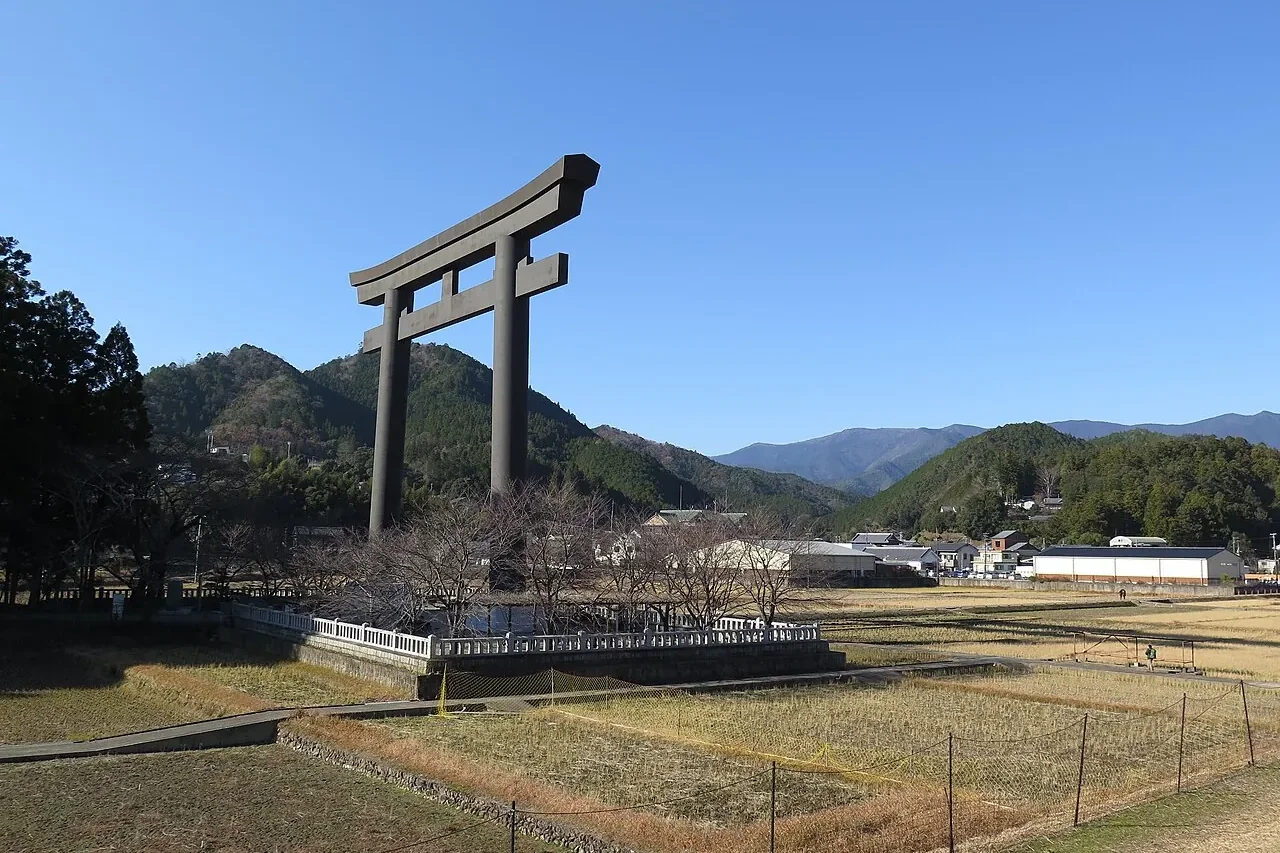
The grand torii at Oyunohara, Kumano Hongu. Photo: Douglas Perkins / Wikimedia Commons / CC BY 4.0
- The tourism bureau's suggested walk is two days from Takijiri to Kumano Hongu Taisha, after a night in Tanabe and with a night in Chikatsuyu; day two is 9–12 hours on its section page, so in short-day seasons shorten it by bus, for example by starting at Hosshinmon-oji, 2–3 hours' walk from Hongu.
- From Osaka, the limited express Kuroshio reaches Kii-Tanabe in about 2 hours from Shin-Osaka, and the bus to the Takijiri trailhead takes about 40 minutes for ¥970. Even on the first train and bus from Osaka or Kyoto there is not enough time to walk to Chikatsuyu the same day, the bureau says.
- Lodging is booked through Kumano Travel, where requests close 20 days before your stay; bookings are not instant, and the same site arranges luggage between inns.
Sleep in Tanabe, take the morning bus to Takijiri, and walk the Nakahechi to Hongu in two days; when the days are short, ride part of day two by bus.
The tourism bureau's suggested walk starts with a night in Tanabe. If you come from Osaka or Kyoto on the day, it suggests stopping at Takahara instead of Chikatsuyu; that gets you to a bed on the first day, but it does not shorten day two.
Day two, Chikatsuyu to Hongu, is 9–12 hours on the bureau's section page, and the bureau asks you to arrive before dark. The Kii-Tanabe – Hongu bus stops at villages on the way, such as Chikatsuyu and Nonaka, and some trips go on to Hosshinmon-oji, 2–3 hours' walk from Hongu, so you can shorten it.
Lodging in the mountains is small and must be booked ahead, so fix your nights first and the walk around them.
- 1Nakahechi, Takijiri – Hongu2 days after a night in Tanabe; buses beside the route
- 2Kohechi70 km over three passes above 1,000 m
- 3Ohechi along the coastOne section closed to about April 2027
- Prefecture
- Wakayama
- Main route
- Nakahechi, open year-round
- Trailhead
- Takijiri, about 40 min by bus
- World Heritage
- Since July 7, 2004
From Kii-Tanabe Station, without a car
- Takijiri trailheadStart of the Nakahechi; ¥97040 min
- Kumano Hongu TaishaHongu Taisha-mae stop; ¥2,1002 hr
- Yunomine, Kawayu, WataraseOnsen towns, from Hongu Taisha-mae; ¥3105–21 min
- Bag storageTANABE tourist information, per bag per day¥500
Fares and times from the Tanabe City Kumano Tourism Bureau's timetables, checked October 25, 2026.
The Kumano Kodo is a network of old pilgrimage roads across the mountains of the Kii Peninsula in Wakayama, leading to the three grand shrines of Kumano. You can walk it without a car: a train to Kii-Tanabe, a bus to the trailhead, the trail itself, and buses again from Hongu. This guide covers which route to pick, how to get there, the buses, luggage and lodging.
Times, fares and rules below come from the Tanabe City Kumano Tourism Bureau, its booking site Kumano Travel, Ryujin Bus, Nanki-Shirahama Airport, Wakayama Prefecture and the Japan Meteorological Agency, checked October 25, 2026.
For a walk on Japan's other famous old road, see my Nakasendo Trail guide.
Why walk the Kumano Kodo
The routes lead to the Kumano Sanzan, the three grand shrines of Kumano: Kumano Hongu Taisha, Kumano Hayatama Taisha in Shingu and Kumano Nachi Taisha. Wakayama Prefecture says the roads were inscribed as part of a World Heritage Site on July 7, 2004, and that more sites were added on October 24, 2016.
- Kumano Hongu Taisha: the end of the classic Nakahechi walk. The great torii at Oyunohara, the shrine's old site, is 33.9 m tall.
- Kumano Nachi Taisha: next to Nachi Falls, 133 m high and 13 m wide, by the tourism bureau's figures.
- Hot springs: Yunomine, Kawayu and Watarase are a short bus ride from Hongu, so a walk can end in an onsen town.
Which route to walk
Several routes reach the shrines. The tourism bureau's pages cover them in different depth:
| Route | What the tourism bureau says |
|---|---|
| Nakahechi | Open year-round; described section by section with distance and time |
| Kohechi | Three passes over 1,000 m along its 70 km; not recommended in winter |
| Ohechi | Rarely snowy; one section closed to April 30, 2027 (estimated) |
For a first walk without a car I would pick the Nakahechi. The bureau describes it section by section, and the bus from Kii-Tanabe stops at villages along it, including Kurisugawa, Chikatsuyu and Nonaka, so you have options if the weather turns. The Kohechi crosses three passes above 1,000 m, and the bureau does not recommend it in winter because of snow. The Dual Pilgrim page lists Koyasan to Hongu, about 65 km, as one of its set walks.
On October 25, 2026 the tourism bureau listed a closure on the Ohechi between Wabuka and Tako stations from June 8, 2026 to April 30, 2027 (estimated), a detour over the peak on the north side of the Obako-toge Pass on the Kohechi, and a closure with no reopening date on the Mandala-no-michi between Nachi Station and the Ama-shogun memorial in Nachikatsuura. Conditions change after heavy rain, so check the trail tips page shortly before you go.
The classic walk: Takijiri to Hongu in two days
The tourism bureau's suggested walk takes two days from Takijiri-oji, at the start of the Nakahechi, to Kumano Hongu Taisha, with a night in Chikatsuyu. It says you will need to stay the first night in Tanabe and take the bus to Takijiri the next morning: even on the earliest train and bus from Osaka or Kyoto, there is not enough time to walk from Takijiri to Chikatsuyu. If you do come from Osaka or Kyoto on the day, the bureau suggests sleeping at Takahara instead (see below).
| Day | Section | Distance | Walking time | Climb |
|---|---|---|---|---|
| 1 | Takijiri-oji – Chikatsuyu-oji | about 13.3 km | 6–8 hours | about 1,010 m up |
| 2 | Chikatsuyu-oji – Kumano Hongu Taisha | about 24.5 km | 9–12 hours | about 1,100 m up, 1,380 m down |
These are the figures on the bureau's section pages. Its suggested-walk page gives shorter times for the same days, about 16 km and around 6 hours for day 1 and about 24.5 km and around 9 hours for day 2, so I plan on the longer section-page times. On the bureau's difficulty scale, which runs from 1 (casual walkers) to 5 (experienced walkers in good condition), the section page rates day 2 at 4, so it is a long day.
The bureau asks walkers to plan to arrive before dark, ideally between 15:00 and 17:00, and says nightfall comes early in late fall, winter and early spring, earlier still in the valleys. It treats a headlamp as something to carry for emergencies, not for walking at night. With 9–12 hours of walking, day 2 leaves little margin for that even with an early start, so in late fall and winter, or at a slower pace, ride part of it by bus rather than walking it all. Ways to change the plan:
- Ride to Hosshinmon-oji (shortens day 2): Hosshinmon-oji to Kumano Hongu Taisha is about 7.5 km and 2–3 hours on the bureau's 2024 page of walk options between Chikatsuyu and Hongu. Some buses from Chikatsuyu and Nonaka go there; on others you change at Hongu Taisha-mae. The bus times on that page are from 2024, so check the current timetable.
- Ride to Kobiro-toge or Doyukawa-bashi: the same page gives about 18 km and 7–10 hours to Hongu from Kobiro-toge, or about 17 km and 6–9 hours from Doyukawa-bashi, so this is still a full day.
- Stop at Nonaka (shortens day 2 only a little): Chikatsuyu-oji to Tsugizakura-oji is 4 km, about 1 hour 15 minutes, but Tsugizakura-oji to Hongu is still about 21 km, 8–11 hours. The bus stops at Nonaka, near Tsugizakura-oji.
- Start late, stop at Takahara (for day 1): Takahara is about 4 km and 2–3 hours from Takijiri, with a climb of about 430 m, so it suits an afternoon arrival, and it is where the bureau suggests sleeping if you come from Osaka or Kyoto on the day. It adds a night, Takahara, then Chikatsuyu, then Hongu, but the long walk from Chikatsuyu to Hongu stays the same. Takahara has no bus stop; the nearest is Kurisugawa, about 30 minutes' walk away.
Getting there without a car
From Osaka and Kyoto: the Kuroshio to Kii-Tanabe
The JR limited express Kuroshio runs down the Wakayama coast to Kii-Tanabe, the gateway to the Nakahechi. The tourism bureau gives these times:
| From | To Kii-Tanabe |
|---|---|
| Tennoji | 1 hour 45 minutes |
| Shin-Osaka | 2 hours |
| Kyoto | 2 hours 35 minutes |
The bureau notes that train times sometimes change, and its page does not give fares.
From Tokyo: fly to Nanki-Shirahama
On the airport's timetable for October 25, 2026 to January 4, 2027, JAL flies from Haneda to Nanki-Shirahama three times a day, at 7:45, 11:45 and 16:15, arriving at 9:00, 13:00 and 17:30. The bus timetable to Hongu lists Nanki Shirahama Airport as a stop on some trips, before Kii-Tanabe; I have not confirmed the time or fare from the airport. You can also take the Shinkansen to Shin-Osaka and change to the Kuroshio.
From Nagoya
The limited express Nanki runs from Nagoya to Kii-Katsuura in about 4 hours, the bureau says, stopping at Shingu. That puts you at the Nachi and Shingu end of the routes rather than at Takijiri.
Getting to Kii-Tanabe from Tokyo or Osaka
Fly from Haneda to Nanki-Shirahama, about 1 hour 10 minutes, or go by Shinkansen to Shin-Osaka and change to the Kuroshio.
Limited express Kuroshio: about 2 hours from Shin-Osaka and 1 hour 45 minutes from Tennoji to Kii-Tanabe, the tourism bureau says.
Buses to the trailhead and on to Hongu
Kii-Tanabe Station – Takijiri – Kumano Hongu Taisha
- Ryujin Bus and Meiko Bus share the road. On the tourism bureau's timetable from September 19, 2026, the first bus leaves Kii-Tanabe at 6:16 and reaches Takijiri at 6:52; the 8:37 reaches Takijiri at 9:15.
- Fares (adult, one way): ¥970 to Takijiri, ¥2,100 to Hongu Taisha-mae. The local bus takes about 2 hours to Hongu.
Two ways to pay less or travel faster:
- Ryujin Bus 4-day ticket: ¥5,000 for adults, for four days from first use, on Ryujin Bus routes 80, 81, 84 and 85 only. It is not valid on Meiko Bus, which also runs on this road, so check the operator of each bus. Buy it on QUICK TRIP (digital) or at the Tanabe City tourist center (paper). The ¥5,000 price applies from September 1, 2026, when Ryujin Bus raised it from ¥3,500. Ryujin Bus has also applied to change its route bus fares from February 25, 2027, subject to approval; its notice does not mention the 4-day ticket.
- Autumn rapid bus: from September 19 to December 10, 2026, a trial rapid bus runs once a day each way. It leaves Kii-Tanabe at 6:55, reaches Takijiri at 7:27 and Hongu Taisha-mae at 8:40. No booking is taken; seats are first come, first served, a full bus cannot take more passengers, and a separate rapid fare applies (I have not confirmed the amount).
From Hongu: the onsen towns, Shingu and Nachi
- Onsen towns: buses from Hongu Taisha-mae to Yunomine, Kawayu and Watarase cost ¥310, and take about 5–21 minutes depending on the town and the bus, on the April 1, 2026 timetable.
- Shingu and Nachi: there is no direct bus from Hongu to Nachisan, the tourism bureau says. The bus from the Hongu area to Shingu costs ¥1,560–1,570 and arrives on the north side of the Hayatama Taisha-mae stop. Change there to a bus to JR Nachi Station or Kii-Katsuura, which leaves from the south side, then take the bus up to Nachisan. The bureau puts the whole trip at about ¥2,580 and 2 hours 15 minutes via Nachi Station, or about ¥2,780 and 2 hours 35 minutes via Kii-Katsuura, and the time depends on connections. At Nachi Station the Nachisan bus leaves from a different stop. I have not confirmed the time from Hongu to Shingu alone.
Luggage on the Kumano Kodo
Kumano Travel arranges luggage between lodgings booked through it. Book at least 20 days in advance; it cannot be arranged on the day in Tanabe. Prices depend on the company and the section, so check each one when you book. Cancelling the luggage shuttle costs 40% the day before until 17:00 and 100% after that.
- The TANABE tourist information center, next to Kii-Tanabe Station, keeps bags for ¥500 per bag per day.
- If you walk with your bag, keep it small: day 2 climbs about 1,100 m.
Where to stay
The tourism bureau describes minshuku, the family-run guesthouses common in rural Japan, as small places with few rooms, and it says pre-booking is very important, especially in the mountains; some places close on nights with no bookings. Kumano Travel, the bureau's booking site, works like this:
- You send a reservation request, at least 20 days before your stay. Bookings are not instant; the site checks availability after it receives the request.
- When the request is processed, you pay by credit card within 48 hours to confirm it.
- Cancelling more than 20 days before is free; after that, fees run from 20% of the total (8–20 days before) to 50% on the day. Once the lodging's check-in time has begun, or for a no-show, it is 100%.
- Cancel from your MyPage account on Kumano Travel. Its office works weekdays 9:00–17:00 Japan time; a request sent outside those hours is processed the next working day, and the fee is set when it is processed. The luggage shuttle has its own fees (see above).
Kumano Travel says the busiest times are Japanese national holidays, and that over New Year, Golden Week and Obon lodgings are often fully booked and prices go up. Kumano Travel also notes that meals are often included, with dinner from around 18:00, and that a local hot spring tax of ¥150 is sometimes paid directly to the lodging. In the tiny settlement of Koguchi, on the way from Hongu to Nachi, the bureau notes that rooms are limited.
Seasons in brief
The tourism bureau says the Nakahechi is open year-round and that spring and fall are the popular seasons. Open year-round does not mean every day is safe to walk: the bureau asks walkers to avoid extreme weather and to check the weather and with their lodging each day before setting out. Summers are often hot, humid and wet, and from the end of December to the end of February there is a chance of freezing temperatures and snow, though snow on the passes often melts during the day or stays for a couple of days. The bureau also warns that heavy rain and wind, especially from typhoons, can cause flash flooding and landslides, and that JR trains sometimes stop or run late because of them. At Kurisugawa, near the Nakahechi, the Japan Meteorological Agency's normals give 387.5 mm of rain in June and 395.0 mm in July, against 134.0 mm in November. Month by month, with festival dates and closures, it is all in my guide to when to hike the Kumano Kodo.
Tourist information and the Dual Pilgrim
- TANABE tourist information center: next to Kii-Tanabe Station, open 9:00–18:00 every day. Pick up timetables here before the bus.
- Kumano Kodo-kan at Takijiri: open 8:30–17:15.
- Kumano Hongu Heritage Center: 9:00–17:00 on the information centers page (the Dual Pilgrim page says 8:30–17:00).
The Dual Pilgrim is for walkers who complete both the Camino de Santiago, at least the last 100 km on foot (or 200 km by bicycle), and one of the set Kumano Kodo walks. Takijiri to Hongu, about 38 km, is one of them; a shorter option is Hosshinmon-oji to Hongu, about 7.5 km, with visits to Hayatama Taisha and Nachi Taisha.
- Before you walk: pick up the Kumano credential, which is free, at the TANABE tourist information center, the Kumano Kodo-kan at Takijiri, the Kumano Hongu Heritage Center or another listed tourist center, and stamp it at the sites along your route. The completion stamp is at Kumano Hongu Taisha.
- To register: bring the stamped credential and proof that you completed the Camino (a digital copy or photo of your Camino credential is accepted) to the Kumano Hongu Heritage Center or the TANABE tourist information center. The TANABE center says no advance registration is needed.
- Kuroshio fares, and the time from Nagoya to Shingu alone
- The time from Hongu to Shingu alone, the last bus from Hongu back to Kii-Tanabe, and which trips on the Kii-Tanabe line stop short of Hongu or go on to Hosshinmon-oji
- The bus time and fare from Nanki-Shirahama Airport, and the fare on the autumn rapid bus
- Lengths and days for the Ohechi and Iseji, and current conditions on the Iseji
- The number of places to stay at each stop on the Nakahechi
- Admission at the Kumano Hongu Heritage Center, and which of its two listed opening times is current
How I checked this
- Read the train, plane and bus pages of the Tanabe City Kumano Tourism Bureau, its timetables of September 19, 2026 and April 1, 2026, and the flight table on Nanki-Shirahama Airport's site.
- Read the route, section, trail tips, luggage, Dual Pilgrim and information center pages on the tourism bureau's site, and the World Heritage dates on Wakayama Prefecture's page.
- Read the booking steps, payment rules, cancellation fees and FAQs on Kumano Travel, the 4-day ticket on Ryujin Bus, and the climate on JMA's normals.
- Matched every value to a dated source; anything I could not confirm is listed above.
More on the Kumano Kodo

Frequently asked questions
How do I get to the Kumano Kodo without a car?
Take the JR limited express Kuroshio to Kii-Tanabe, about 2 hours from Shin-Osaka, then the bus to the Takijiri trailhead, about 40 minutes for ¥970. Buses on the same road go on to Kumano Hongu Taisha, ¥2,100 from Kii-Tanabe. For the two-day walk the tourism bureau says to stay the first night in Tanabe: even the first train and bus from Osaka or Kyoto leave too little time to walk to Chikatsuyu.
Which Kumano Kodo route should I walk?
For a first walk, the Nakahechi. It is open year-round, though the tourism bureau asks walkers to avoid extreme weather; the bureau describes it section by section with distances and times, and the bus from Kii-Tanabe stops at villages along the way. The Kohechi is 70 km over three passes above 1,000 m and is not recommended in winter.
How long does the Kumano Kodo take?
The classic Nakahechi walk from Takijiri to Kumano Hongu Taisha takes two days, after a night in Tanabe and with a night in Chikatsuyu. The tourism bureau's section pages give about 13.3 km and 6–8 hours for the first day and about 24.5 km and 9–12 hours for the second. The bureau asks walkers to arrive before dark, so in late fall and winter, or at a slower pace, ride part of day two by bus, for example starting at Hosshinmon-oji, about 7.5 km and 2–3 hours from Hongu.
Do I need to book lodging on the Kumano Kodo?
Yes. The tourism bureau says pre-booking is very important, especially in the mountains, and some places close on nights with no bookings. Kumano Travel, the bureau's booking site, takes requests at least 20 days before your stay and confirms them after checking availability; over New Year, Golden Week and Obon lodgings are often fully booked. Cancelling is free only more than 20 days before, and 100% once the lodging's check-in time has begun. Requests sent outside weekday office hours (9:00–17:00 Japan time) are processed on the next working day, and the cancellation fee is set on that day.
Can I send my luggage ahead on the Kumano Kodo?
Yes, between lodgings booked through Kumano Travel, at least 20 days ahead. It cannot be arranged on the day in Tanabe, and cancelling it after 17:00 the day before costs 100%. The TANABE tourist information center next to Kii-Tanabe Station keeps bags for ¥500 per bag per day.
What is the Dual Pilgrim?
A record for walkers who complete both the Camino de Santiago (at least the last 100 km on foot, or 200 km by bicycle) and one of the set Kumano Kodo walks, such as Takijiri to Hongu. It is a good idea to pick up the free Kumano credential before you start, so you can stamp it along the way. You can get one, for example, at the TANABE tourist information center or the Kumano Kodo-kan at Takijiri. To register, bring the stamped credential and proof that you completed the Camino to the Kumano Hongu Heritage Center or the TANABE tourist information center.
Keep planning
Sources
- Getting here by train — Tanabe City Kumano Tourism Bureau
- Getting here by plane — Tanabe City Kumano Tourism Bureau
- Flight timetable (October 25, 2026 – January 4, 2027) — Nanki-Shirahama Airport
- Bus timetable: Kii-Tanabe and Shirahama to Kumano Hongu Taisha (September 19, 2026) — Tanabe City Kumano Tourism Bureau
- Takijiri — Tanabe City Kumano Tourism Bureau
- Kumano Kodo rapid bus, autumn 2026 — Tanabe City Kumano Tourism Bureau
- Kumano Hongu line 4-day free ticket — Ryujin Bus
- Bus timetable: Hongu, Kawayu and Yunomine (April 1, 2026) — Tanabe City Kumano Tourism Bureau
- Kumano Hongu line 4-day ticket price change (August 17, 2026) — Ryujin Bus
- Route bus fare change application (October 26, 2026) — Ryujin Bus
- Hongu to Shingu and Nachisan by bus — Tanabe City Kumano Tourism Bureau
- Kumano Kodo routes — Tanabe City Kumano Tourism Bureau
- Suggested walks — Tanabe City Kumano Tourism Bureau
- Takijiri-oji to Chikatsuyu-oji — Tanabe City Kumano Tourism Bureau
- Chikatsuyu-oji to Kumano Hongu Taisha — Tanabe City Kumano Tourism Bureau
- Takijiri-oji to Takahara — Tanabe City Kumano Tourism Bureau
- Difficulty rating — Tanabe City Kumano Tourism Bureau
- Weather and trail conditions (Japanese) — Tanabe City Kumano Tourism Bureau
- Lodging types — Tanabe City Kumano Tourism Bureau
- Kumano Hongu Taisha — Tanabe City Kumano Tourism Bureau
- Mandala-no-michi closure (July 2, 2026) — Tanabe City Kumano Tourism Bureau
- Trail tips and conditions — Tanabe City Kumano Tourism Bureau
- World Heritage additional registration (2016) — Wakayama Prefecture
- Kumano Nachi Taisha — Tanabe City Kumano Tourism Bureau
- Dual Pilgrim — Tanabe City Kumano Tourism Bureau
- Dual Pilgrim registration and credential — Tanabe City Kumano Tourism Bureau
- Walk options between Chikatsuyu/Nonaka and Kumano Hongu Taisha (April 18, 2024) — Tanabe City Kumano Tourism Bureau
- Hongu area to Nachisan routes — Tanabe City Kumano Tourism Bureau
- Kumano Travel terms and conditions (PDF, revised October 20, 2022) — Kumano Travel
- Luggage shuttle and storage — Tanabe City Kumano Tourism Bureau
- Information centers — Tanabe City Kumano Tourism Bureau
- How to book — Kumano Travel
- Terms and conditions — Kumano Travel
- FAQs — Kumano Travel
- Kogumotori-goe — Tanabe City Kumano Tourism Bureau
- Climate normals, Kurisugawa (1991–2020) — Japan Meteorological Agency