Kamikochi Without a Car: Things to Do, Buses and Where to Stay
A mountain valley at about 1,500 m where private cars cannot go, reached by bus from Matsumoto or Takayama from April 17 to November 15.
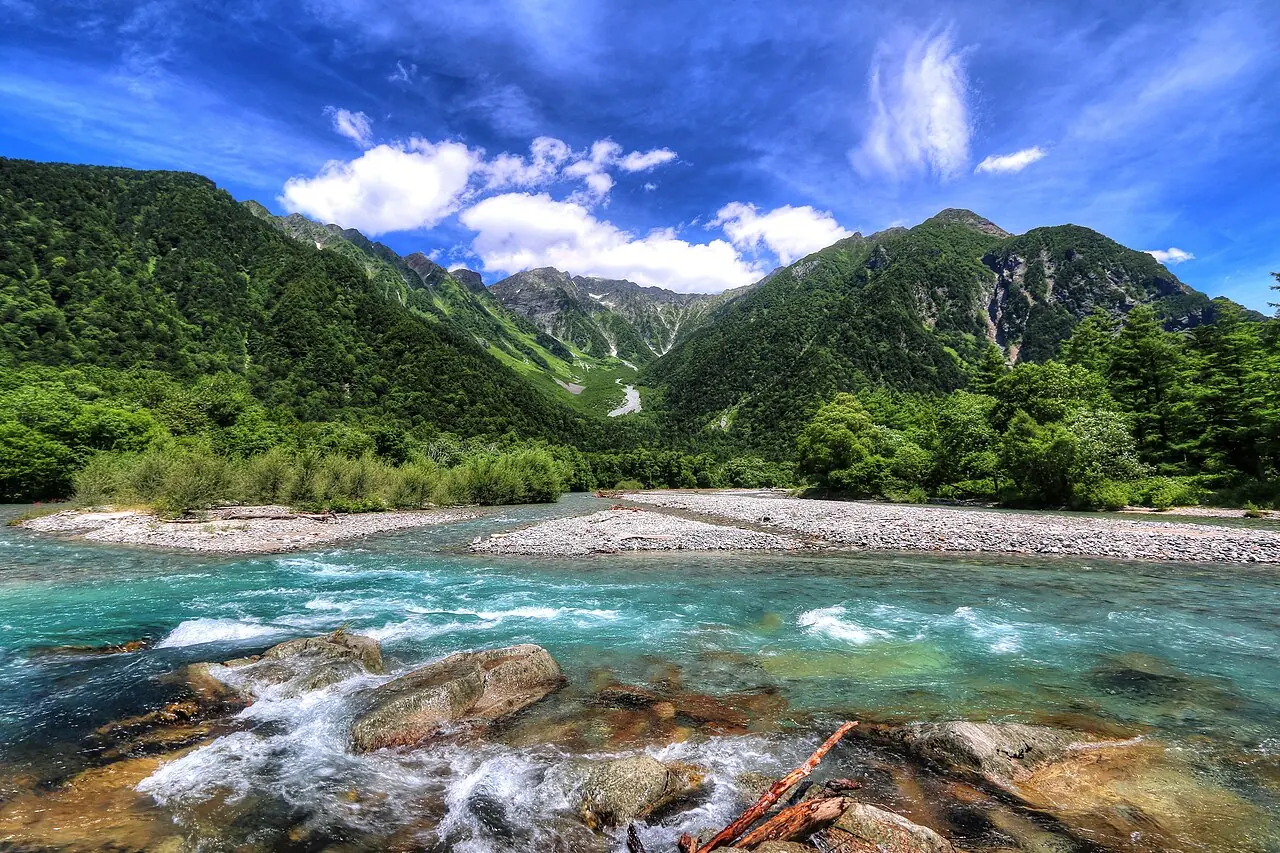
The Azusa River in Kamikochi in July. Photo: くろふね / Wikimedia Commons / CC BY 3.0
- Kamikochi is open from April 17 to November 15, 2026; after that no bus goes in until mid-April, and only two ryokan on the official list stay open.
- Private cars cannot go past the Kama Tunnel, so you come by bus: from Matsumoto by train and bus via Shin-Shimashima (about 30 minutes, then 1 hour 5 minutes), or from Takayama with a change at Hirayu Onsen (about 1 hour 30 minutes).
- The walks are flat: Kappa Bridge is 6 minutes from the bus terminal, Taisho Pond about 1 hour 15 minutes and Myojin Pond 50 minutes to an hour from the bridge.
Come by bus, walk from Kappa Bridge, and stay a night if you want the early morning.
Every way in without a car is a bus, and the walks start a few minutes from the bus terminal, so you need no transport inside Kamikochi.
A day trip works from Matsumoto or Takayama. A night inside lets you walk early and late without a bus to catch, and go as far as Tokusawa.
- 1From MatsumotoTrain to Shin-Shimashima, then the bus
- 2From TakayamaNohi Bus, change at Hirayu Onsen
- 3DrivingPark at Sawando or Hirayu, then the shuttle
- Prefecture
- Nagano
- Elevation
- About 1,500 m
- Open
- April 17 – November 15, 2026
- Private cars
- Not allowed past the Kama Tunnel
From Kamikochi Bus Terminal, on foot and by bus
- Kappa BridgeThe suspension bridge over the Azusa River6 min
- Myojin PondAdmission ¥300; from Kappa Bridge50 min – 1 hr
- Taisho PondFrom Kappa Bridge on the right bank1 hr 15 min
- TokusawaFlat but long; from Kappa Bridge2 hr+
- Hirayu OnsenNohi Bus, change here for Takayama25 min
- Shin-ShimashimaAlpico bus, then the train to Matsumoto1 hr 5 min
Times checked October 15–24, 2026; buses run April 17 – November 15, 2026.
Kamikochi is a mountain valley in the Japanese Alps of Nagano Prefecture, at about 1,500 m, where the Azusa River runs below the Hotaka peaks. You cannot drive in, so the valley is built for people who arrive by bus and walk. This guide covers when it is open, how to get there from Matsumoto and Takayama, the walks from Kappa Bridge and where to stay.
Dates, times and fares below come from the official Kamikochi site, Nagano Prefecture, Alpico Kotsu and Nohi Bus, checked October 15–24, 2026.
Kamikochi sits between Takayama and Matsumoto on the car-free corridor in my Japanese Alps without a car guide.
Why go to Kamikochi
Kamikochi has been part of the Chubu-Sangaku (Japan Alps) National Park since December 4, 1934, and since 1952 it has been a Special Place of Scenic Beauty and a Special Natural Monument, the official site says. About 1.2 million people visit each year.
The valley was made known abroad by Walter Weston, an English missionary who published Mountaineering and Exploration in the Japanese Alps in 1896 and is called the father of modern mountaineering in Japan. A monument to him stands on the walk between Kappa Bridge and Taisho Pond.
Two sights frame a first visit:
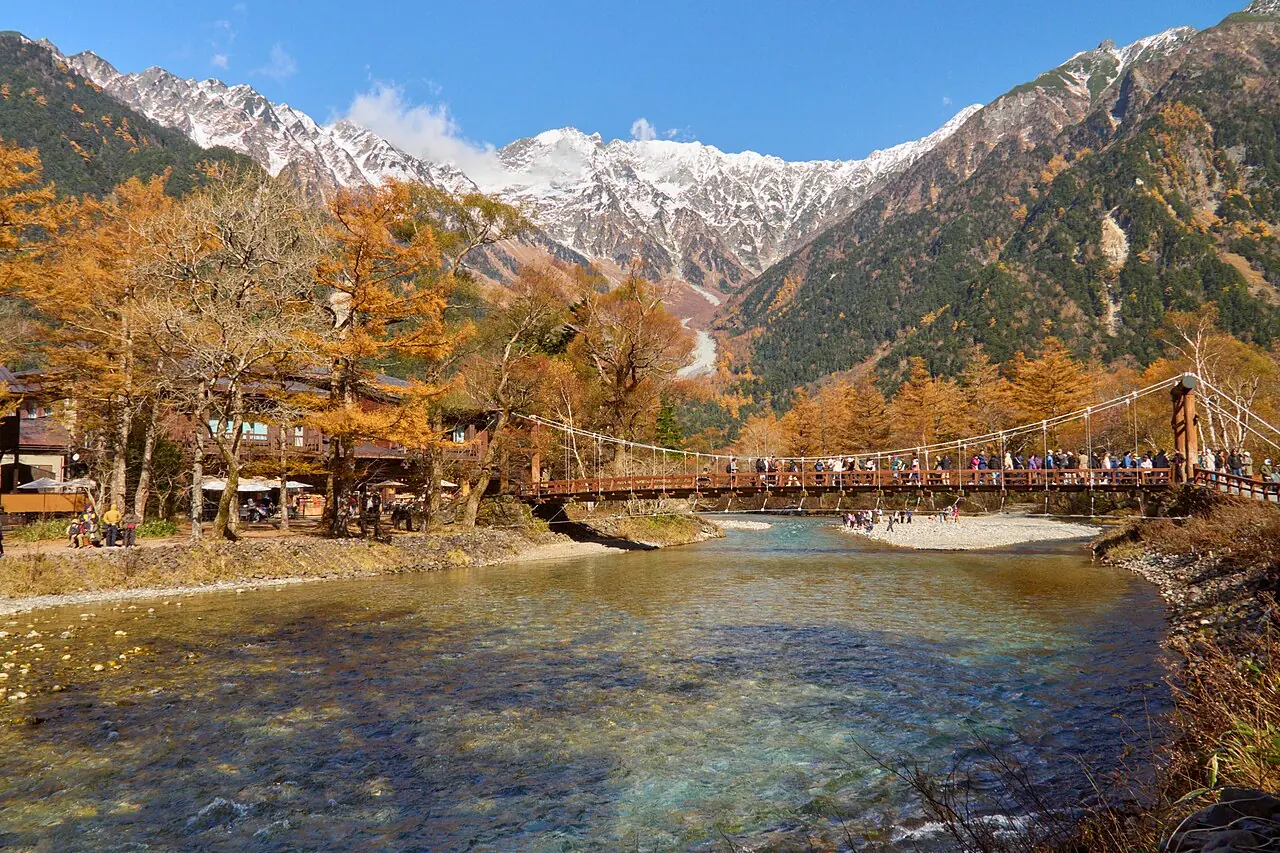
- Kappa Bridge is a wooden suspension bridge over the Azusa River near the bus terminal. Upstream you see the Hotaka peaks and Mount Myojin; downstream, Mount Yakedake.
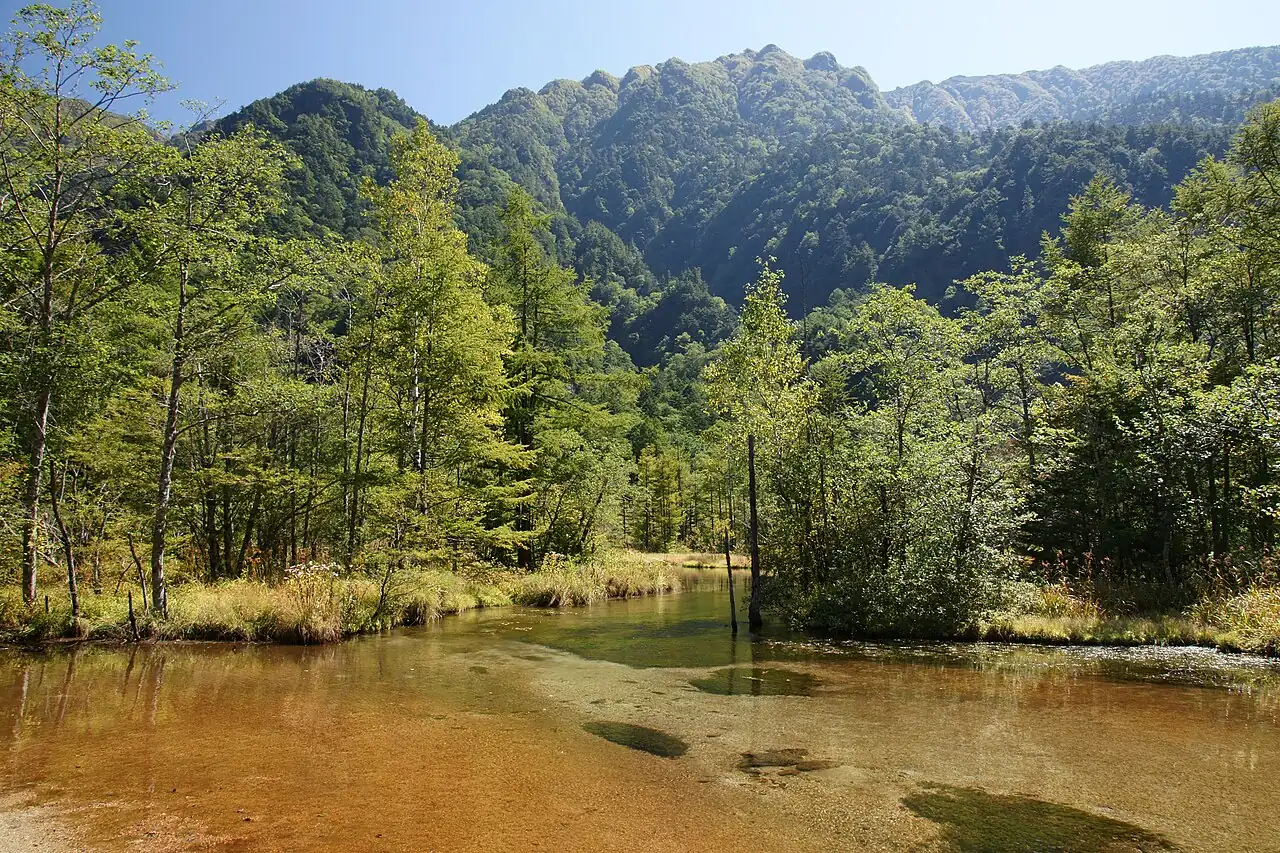
- Taisho Pond formed when Yakedake erupted in 1915 and a mudflow dammed the Azusa River. It has shrunk to less than half its first size; the official site calls it a mirror of the mountains.
When Kamikochi is open
Kamikochi opens on April 17 and closes on November 15, 2026. The official English site gives the season as "Open Apr 17 (Grand Open Apr 27) - Nov 15", and Alpico says some lodgings and shops have not opened yet when the buses start on April 17.
The 2026 season ends with the closing ceremony on November 15. From November 16 to mid-April the official FAQ says the facilities are closed and no transport goes past the Kama Tunnel; only Nakanoyu and Sakamaki, two ryokan on its lodging list, are listed as open all year. The FAQ calls a winter visit self-reliant winter mountaineering that needs an entry form.
| Season | What you see | Without a car |
|---|---|---|
| Late May – early June | Fresh green; Nirinso flowers at Tokusawa in early June | Buses run |
| Mid-June – early July | Flowers in Tashiro Marsh | Buses run |
| July – August | Flowers | Buses run |
| Early – late October | Autumn colors | Buses run; Myojinkan's last night is October 31 |
| Nov 16 – mid-April | Closed | No buses |
The times come from the official site's FAQ and walking page. It warns that mornings and evenings are much colder than the day in spring and autumn, and that even summer can feel chilly in cloud, rain or wind.
| Month (2022 average) | High | Low |
|---|---|---|
| May | 16.2°C | 4.7°C |
| July | 23.0°C | 13.7°C |
| October | 12.5°C | 3.6°C |
| Early November | 8.9°C | −1.1°C |
The figures are the official site's 2022 averages, not long-term normals. For spring and autumn it suggests a fleece, a down jacket, gloves and a hat.
Getting to Kamikochi without a car
Private cars, rental cars and motorbikes cannot go past the Kama Tunnel at any time of year. During the 2026 season (April 17 – November 15), only buses, taxis, bicycles and other light vehicles can use the road, Nagano Prefecture says.
From Matsumoto: train and bus via Shin-Shimashima
Take the Alpico Kamikochi Line train from Matsumoto Station to Shin-Shimashima (about 30 minutes, ¥710), then the bus from Shin-Shimashima to Kamikochi (about 1 hour 5 minutes, ¥3,100). The train leaves from platform 7 at Matsumoto Station and the bus from stop 1 at Shin-Shimashima. On the May 1, 2026 timetable the first train leaves Matsumoto at 6:31 and its bus reaches Kamikochi at 8:15; the last connection leaves Matsumoto at 14:47 and arrives at 16:35.
Alpico also runs the National Park Liner from Matsumoto Bus Terminal, across the street from the station's Castle (east) exit, from stop 9: the 5:30 bus reaches Kamikochi at 7:05 (¥5,000, early-morning surcharge included) and the 10:15 bus at 11:55 (¥4,600).
Alpico's Kamikochi buses give priority to booked passengers, and you can still board without a booking if seats are left. Bookings open at 0:00 one month before the travel date, online (Hassha Orai Net) with no phone bookings; the counters at Matsumoto, Shin-Shimashima and Kamikochi bus terminals also sell tickets. A booking is for a bus, not a seat, and you board in the order you queue. Buses back leave from stop 4 at Kamikochi Bus Terminal. For times and the return, see my Matsumoto to Kamikochi guide.
From Takayama: Nohi Bus via Hirayu Onsen
Take Nohi Bus from the Nohi Bus Center in Takayama to Hirayu Onsen and change there for Kamikochi, about 1 hour 30 minutes in all. A connecting ticket costs ¥3,000 one way, or ¥5,800 return valid 7 days. The Nohi Bus Kamikochi line takes no reservations.
The first bus leaves Takayama at 7:00, or at 6:00 from July 19 to August 24; the 6:00 bus connects at Hirayu with the 7:00 bus, which reaches Kamikochi at 7:25. Coming back, the last Hirayu – Takayama bus leaves Hirayu at 17:30. Take the 16:30 bus from Kamikochi (Hirayu 16:55): the 17:00 bus reaches Hirayu at 17:25, a 5-minute change that Nohi Bus does not mark as a connection, and the 17:30 bus does not connect. See my Takayama to Kamikochi guide for the bus times.
Matsumoto — train and bus
- Train to Shin-Shimashima about 30 min (¥710), then the bus about 1 hr 5 min (¥3,100).
Takayama — bus via Hirayu
- Nohi Bus to Hirayu Onsen, then on to Kamikochi: about 1 hr 30 min, ¥3,000 one way on a connecting ticket.
If you come by car: Sawando or Hirayu
Drivers park at Sawando (Nagano side) or Hirayu Akandana (Gifu side) and take the shuttle bus or a taxi. The shuttle from Sawando takes about 30 minutes and runs about every 30 minutes, ¥1,600 one way. A taxi from the upper Sawando zone to Kamikochi Bus Terminal has a fixed fare of ¥5,400 in a standard car; from the Hirayu Onsen zone the fare table gives up to ¥6,000, plus ¥1,580 for the Abo Tunnel toll (both ways, as the taxi returns empty). The last taxi pickup is at 18:00.
Things to do in Kamikochi: the valley walks
The paths along the Azusa River are flat, and the official site times them at about 3 km an hour, without stops.
| Walk | Time one way | Distance |
|---|---|---|
| Bus terminal – Kappa Bridge | about 6 min | 0.3 km |
| Kappa Bridge – Taisho Pond (right bank) | about 1 hr 15 min | 3.8 km |
| Kappa Bridge – Taisho Pond (left bank) | about 1 hr 20 min | 4.0 km |
| Kappa Bridge – Myojin (left bank) | about 50 min | 2.5 km |
| Kappa Bridge – Myojin (right bank) | about 1 hr | 3.0 km |
| Myojin – Tokusawa | 1 hr | 3.0 km |
| Tokusawa – Yokoo | 1 hr 10 min | 3.5 km |
Taisho Pond and Tashiro Pond. Get off the bus at the Taisho Pond stop, a minute from the water, and walk back to the bus terminal past Tashiro Pond and the Weston Monument. Tashiro Marsh has flowers from mid-June to early July.
Myojin Pond. Admission to the pond is ¥300. The official English site says its water has great significance in Shinto, and that the Hotaka Shrine holds the Omizugaeshi ceremony every year. Walk out on one bank and back on the other: the official site says the right bank is less crowded in spring and summer.
Tokusawa and Yokoo. Past Myojin the path goes on to Tokusawa, a little over 2 hours from Kappa Bridge one way, and Yokoo, which the official site calls the base for the Yari and Hotaka ridges. It calls this stretch flat but long and suggests training before you go, rain gear and comfortable walking shoes.
Seven places offer day bathing, including the Kamikochi Onsen Hotel, the Lemeiesta, the Alpen Hotel and Tokusawa Lodge. The official list did not give hours or prices.
Rules on the trails
- Do not pick plants or catch insects.
- Do not feed wild animals.
- Take all your rubbish home.
- Do not bring pets (assistance dogs aside) or non-native species.
- Stay on the paths.
- Do not ride bicycles into the mountain areas, and do not fly drones.
Most public toilets ask for a tip in a box at the door; at the bus terminal you pay an attendant. Toilets on the walks are far apart in places, so check the map first. Alpico does not allow bear spray on its buses.
Where to stay in Kamikochi
The official site lists 18 places to stay, from hotels around Kappa Bridge to lodges as far up as Tokusawa and Yokoo. The mountain huts have shared rooms and optional meals. The English site gives each one's walking distance from the bus terminal but no prices.
Myojinkan takes its last guests on October 31, several lodges on November 3 or 4 and most hotels on November 14. On the official notice of October 6, 2026, the last nights of the 2026 season were:
| Lodging | Last night in 2026 |
|---|---|
| Myojinkan | October 31 |
| Konashi, Yama no Hidaya, Tokusawaen, Yokoo Sanso | November 3 |
| Kamonjigoya, Tokusawa Lodge | November 4 |
| Taishoike Hotel | November 13 |
| Imperial Hotel, Kamikochi Onsen Hotel, Lemeiesta, Alpen Hotel, Nishi-Itoya, Gosenjaku, The Park Lodge, Shirakabaso | November 14 |
| Nakanoyu Onsen Ryokan, Sakamaki Onsen Ryokan | Open all year, with closed days |
Booking differs by lodging, the English site says:
- Myojinkan does not take bookings just before your stay; it suggests booking at least two weeks ahead.
- Yokoo Sanso and the Yokoo campsite take bookings by phone only.
- Nakanoyu and Sakamaki cannot take online booking requests in English; Kamonjigoya can.
A night inside means you can walk early and late and reach Tokusawa without watching the clock for the last bus.
Day trip or a night?
A day trip covers Kappa Bridge, Taisho Pond and Myojin Pond. From Matsumoto the first connection gets you in at 8:15, and the last bus out leaves Kamikochi at 17:55 for Shin-Shimashima (19:00), where the 19:25 train reaches Matsumoto at 19:54. From Takayama, take the 16:30 bus back.
Stay a night if you want Tokusawa or an early start, and book the room before you plan the walk.
- The 2027 season dates: Alpico says Kamikochi is scheduled to open every year from April 17 to November 15, but I did not see a 2027 notice
- Prices at the lodgings (not on the official pages)
- Which lodgings are inside the Kama Tunnel and which are outside
- Hours and prices of the day baths
- Opening hours of Myojin Pond
- Bear safety advice beyond the bus rule on bear spray: the official pages I read did not cover it
How I checked this
- Read the official Kamikochi site in Japanese and English: about, season and clothing, FAQ, rules, walking courses, spots, lodging, day baths, car restrictions and taxi fares.
- Read the Alpico and Nohi Bus pages and timetables for the Kamikochi buses, and Nagano Prefecture's page on the Kamikochi road.
- Matched every value to a dated source; anything I could not confirm is listed above.
Getting to Kamikochi from Tokyo or Osaka
Limited express Azusa from Shinjuku to Matsumoto, then the Alpico train and bus via Shin-Shimashima.
Shinkansen to Nagoya, the limited express Hida to Takayama, then Nohi Bus with a change at Hirayu Onsen.
More on the route

Frequently asked questions
When is Kamikochi open?
From April 17 to November 15 in 2026. The official site gives the season as April 17 (grand opening April 27) to November 15. From November 16 to mid-April the official FAQ says the facilities are closed and no transport runs past the Kama Tunnel; two ryokan on its lodging list, Nakanoyu and Sakamaki, are listed as open all year.
How do I get to Kamikochi without a car?
By bus. From Matsumoto, take the Alpico train to Shin-Shimashima (about 30 minutes, ¥710) and the bus from there (about 1 hour 5 minutes, ¥3,100), or the direct National Park Liner. From Takayama, take Nohi Bus to Hirayu Onsen and change for Kamikochi, about 1 hour 30 minutes in all.
Can I drive to Kamikochi?
Not all the way. Private cars, rental cars and motorbikes cannot go past the Kama Tunnel at any time of year. Park at Sawando or Hirayu Akandana and take the shuttle bus or a taxi; the shuttle from Sawando takes about 30 minutes.
Is Kamikochi worth a day trip?
Yes, if you stay on the flat valley walks. Kappa Bridge is 6 minutes on foot from the bus terminal, Myojin Pond is 50 minutes to an hour from the bridge and Taisho Pond about 1 hour 15 minutes. Tokusawa, a little over 2 hours from Kappa Bridge one way, is easier with a night inside.
What is the best time to visit Kamikochi?
The official site recommends late May to early June for fresh green, July and August for flowers and early to late October for autumn colors.
Can I bring my dog to Kamikochi?
No. The official site asks visitors not to bring pets, except assistance dogs.
Keep planning
Sources
- Kamikochi (home, English) — Kamikochi official website
- About Kamikochi (history and designations) — Kamikochi official website
- Clothing guide (elevation and temperatures) — Kamikochi official website
- FAQ — Kamikochi official website
- Rules and manners — Kamikochi official website
- Walking in Kamikochi (courses and times) — Kamikochi official website
- Taisho Pond — Kamikochi official website
- Kappa Bridge — Kamikochi official website
- Myojin Pond — Kamikochi official website
- Places to stay (list) — Kamikochi official website
- Accommodation (English) — Kamikochi official website
- 2026 season: last night at each lodging (October 6, 2026) — Kamikochi official website
- Day bathing — Kamikochi official website
- Car restrictions for Kamikochi — Kamikochi official website
- Taxi fixed fares — Kamikochi official website
- Kamikochi Park Line: car restriction and winter closure — Nagano Prefecture
- Shin-Shimashima – Kamikochi bus — Alpico Kotsu
- Kamikochi line timetable (May 1, 2026 edition) — Alpico Kotsu
- Kamikochi line fares (2026) — Alpico Kotsu
- Kamikochi buses and winter (English) — Alpico Kotsu
- Takayama – Hirayu – Kamikochi bus — Nohi Bus
- Takayama – Hirayu – Shin-Hotaka bus (English) — Nohi Bus
- Matsumoto Bus Terminal — Matsumoto City Tourism